Category: Process

process related topics

  • EtO, CtO, Smart Customization

    EtO, CtO, Smart Customization

    [av_heading heading=’EtO, CtO, Smart Customization’ tag=’h3′ link_apply=” link=” link_target=” style=’blockquote modern-quote modern-centered’ size=’50’ subheading_active=” subheading_size=’15’ margin=” padding=’10’ color=’custom-color-heading’ custom_font=’#4fafdb’ custom_class=” id=” admin_preview_bg=” av-desktop-hide=” av-medium-hide=” av-small-hide=” av-mini-hide=” av-medium-font-size-title=” av-small-font-size-title=” av-mini-font-size-title=” av-medium-font-size=” av-small-font-size=” av-mini-font-size=”][/av_heading]

    [av_hr class=’default’ height=’50’ shadow=’no-shadow’ position=’center’ custom_border=’av-border-thin’ custom_width=’50px’ custom_border_color=” custom_margin_top=’30px’ custom_margin_bottom=’30px’ icon_select=’yes’ custom_icon_color=” icon=’ue808′ av_uid=’av-r7yyi’]

    [av_image src=’http://ideci.nl/wp-content/uploads/2018/04/Value-perception-crop.png’ attachment=’1384′ attachment_size=’full’ align=’center’ styling=” hover=’av-hover-grow’ link=” target=” caption=” font_size=” appearance=” overlay_opacity=’0.4′ overlay_color=’#000000′ overlay_text_color=’#ffffff’ animation=’no-animation’ admin_preview_bg=” av_uid=’av-6btjt6′][/av_image]

    [av_textblock size=” font_color=” color=” av-medium-font-size=” av-small-font-size=” av-mini-font-size=” av_uid=’av-40y84a’ id=” custom_class=” admin_preview_bg=”]
    In this article, I will explain the difference between Engineering to Order, Configure to Order and Smart Customisation from an engineering point of view.

    There are quite a few companies struggling in their quest for the balance between delivering and standardising customer specific solutions. After all, they want to satisfy the customer and outsmart the competitor, but at the same time achieve a healthy profit margin.

    There are companies that make excellent money with their Engineering to Order, project-based business operations. But who, for whatever reason, want to increase their margin in a more efficient way.

    Inspired by car manufacturers and IKEA, they then take the path of Configure to Order. Sometimes it works, sometimes it partially works, and sometimes it doesn’t work at all. This may have to do with the role and position of the engineering department, where the wishes of your customer are translated into an attractive solution, in the value chain.

    But first, for a better understanding, a brief overview of EtO, CtO and Smart Customization.
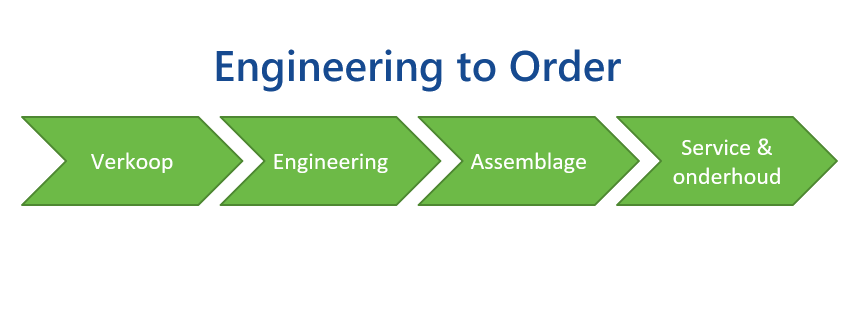
    At EtO, the engineering department is ‘in the chain’. All assignments (orders) are worked out by the engineering department to the level of detail required to build the installation or machine. All customer-specific requirements and wishes are translated into a solution that is largely tailor-made. All new concepts and innovations are developed in the projects. And of course, as one might expect, that brings along some technical, and therefore financial, risks.
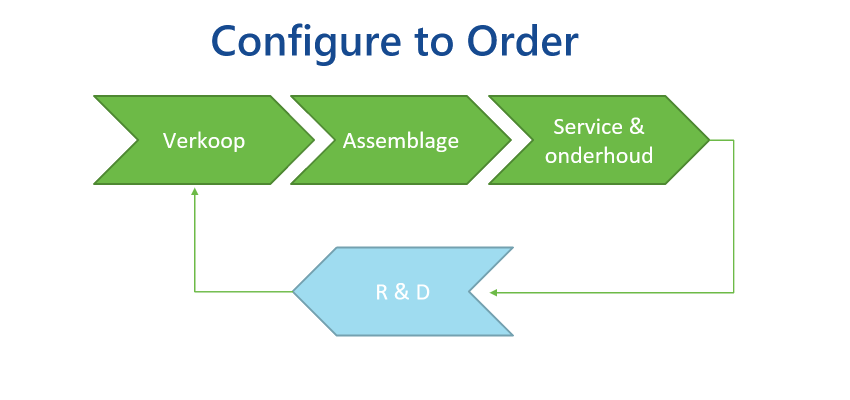
    With CtO, engineering has been removed from the operational chain and placed in a separate department, often referred to as Research and Development. But in fact still the group of people who translate customer / market demand into technical solutions. The big difference, however, is that this feedback from the chain follows a significantly longer route, and takes longer, than with an EtO company. And that’s fine if it can be allowed, or even is desirable, that innovations do not follow each other too quickly.

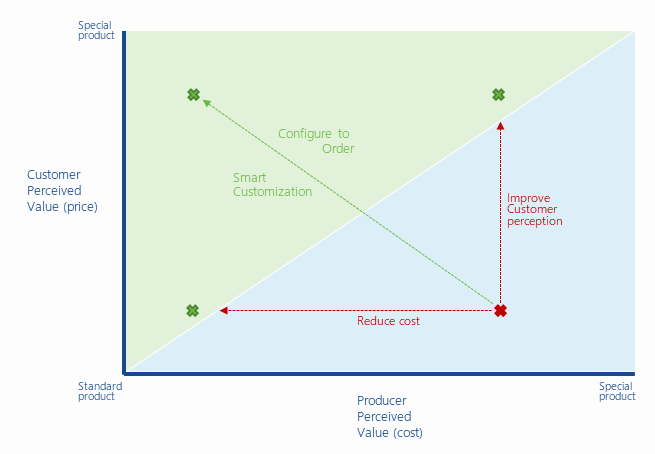
    Car manufacturers and IKEA are successful with this method. But one has to realise that the only way to meet a customer-specific wish in this way is by first supplying the product in accordance with the standard, and then adapting it to the customer’s specification. In practice this is so expensive that it is rarely done. If customer-specific adjustments are allowed during production, the CtO principle will fall apart and one will not enjoy the benefits.

    B
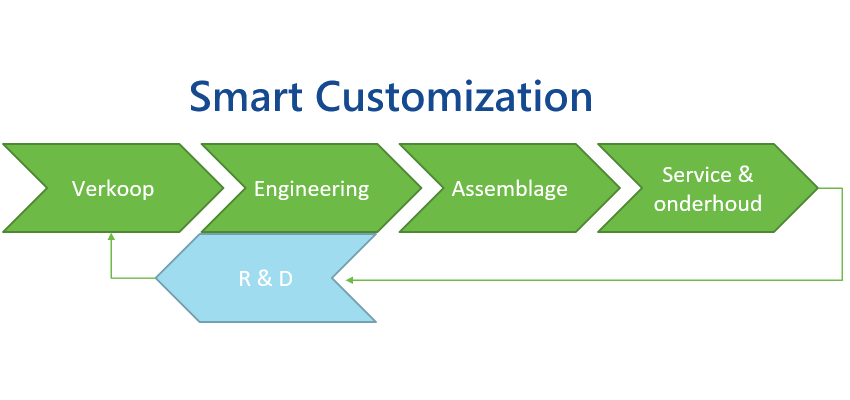
    Smart Customization is a term promoted by consultancy firm IPL. It’s an hybrid form where EtO is combined with CtO. Originated from the awareness that many companies get their competitive and innovative strength from the fact that they make customer-specific solutions.

    A sharp distinction is to be made between what is ‘standard’ and what is ‘special’. The standard part can be built according to CtO principles, the special part according to EtO principles.

    Sounds good? Too good to be true? Perhaps, because as always the case, with all technology, ‘the devil is in the detail’ still applies.
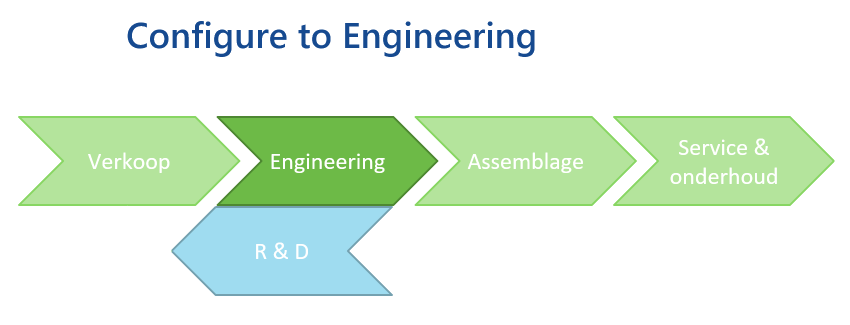
    To make Smart Customization possible, a different approach is required than with CtO. Especially when it comes to making a modular product structure. At CtO, the reasoning is often ‘top-down’, since the product, and all its variants, can be fully mapped out.

    With Smart Customization however, some part of the product is unknown: 5%? 10% 20% 50% is customer specific. And that requires a ‘bottom-up’ approach.

    Configure to Engineering is based on that principle: modules are built by combining the smallest standard parts to the level that is still covered by the standard. Sometimes it’s 50%, sometimes it’s 95%. The remainder is EtO.

    Want to learn more? Get in touch!
    [/av_textblock]

    [av_social_share title=’Share this entry’ style=” buttons=” share_facebook=” share_twitter=” share_pinterest=” share_gplus=” share_reddit=” share_linkedin=” share_tumblr=” share_vk=” share_mail=” av-desktop-hide=” av-medium-hide=” av-small-hide=” av-mini-hide=” av_uid=’av-36ujru’]

  • the World is Flat

    the World is Flat

    [av_heading heading=’the World is Flat!’ tag=’h3′ link_apply=” link=’manually,http://’ link_target=” style=’blockquote modern-quote modern-centered’ size=’50’ subheading_active=” subheading_size=’15’ margin=” margin_sync=’true’ padding=’10’ color=’custom-color-heading’ custom_font=’#4fafdb’ av-medium-font-size-title=” av-small-font-size-title=” av-mini-font-size-title=” av-medium-font-size=” av-small-font-size=” av-mini-font-size=” id=” custom_class=” av_uid=’av-k3x1ne5b’ admin_preview_bg=”][/av_heading]

    [av_hr class=’default’ height=’50’ shadow=’no-shadow’ position=’center’ custom_border=’av-border-thin’ custom_width=’50px’ custom_border_color=” custom_margin_top=’30px’ custom_margin_bottom=’30px’ icon_select=’yes’ custom_icon_color=” icon=’ue808′ av_uid=’av-4rjnvm’]

    [av_image src=’http://ideci.nl/wp-content/uploads/2019/12/Flat-world.jpg’ attachment=’1761′ attachment_size=’full’ align=’center’ styling=” hover=’av-hover-grow’ link=” target=” caption=” font_size=” appearance=” overlay_opacity=’0.4′ overlay_color=’#000000′ overlay_text_color=’#ffffff’ copyright=” animation=’no-animation’ id=” custom_class=” av_uid=’av-21iuua’ admin_preview_bg=”][/av_image]

    [av_textblock size=” font_color=” color=” id=” custom_class=” av-medium-font-size=” av-small-font-size=” av-mini-font-size=” av_uid=’av-k3evwdxz’ admin_preview_bg=”]
    …said the electrical engineer and he continued to work on his 2D-wiring diagrams on the monitor in front of him.

    Odd… I thought… the guys from mechanical engineering just told me that the world was 3 dimensional when they showed me their CAD models. How come?

    “Well… in the early days, we too used 2D drawings.” the mechanical guy explained. “That’s because many tools we used could only work in one pane at a time.” Indeed, making a cut with a saw or groove with a chisel is a two-dimensional operation. But since the use of CNC-controlled multi-axis machinery, and more recent 3D-printers, have become common practice, the mechanical engineer needs a 3D-engineering tool to get the most out of these. And …

    it just makes sense: a 3D-What-You-See-Is-What-You-Get- model is always more intuitive to us humans then a 2D abstraction of the final product.

    Unlike machining of mechanical parts, control cabinet assembly is still, for the most part, done by hand. The wiring diagram shows how the wires connect the electrical components. A lay out shows how these components should be arranged on the back plane. The electrical engineer is more focussed on (electrical-) energy distribution then on physical outline and dimensions. The people in the cabinet workshop will figure out how it all will fit together… or not.

    So, in some way, it makes sense when electrical engineers state that the world is flat: a perspective that meets their needs. On the other hand… this is the 21st century!! 3D is all around us (TV, cinema, printers, engineering tools), why not use it? What if … an electrical engineer would just start ‘building’ a 3D-cabinet on his workstation and generate 2D-drawings, wiring diagrams a.s.o. based on that model??

    While chewing over that thought I pulled a cup of coffee from the machine and told the software engineer next to me about these 2D-electrical engineers. He gazed at me and said: “Two dimensions? Are you out of your mind??? It’s a binary world! One and Zero. On and Off. And already its driving me crazy sometimes!! One dimension is more then enough to get me into trouble!!”

    And off he went to a meeting with his next dead line, obviously running out of time and good ideas …
    [/av_textblock]

  • On Systems Architecture Principles & Practices

    On Systems Architecture Principles & Practices

    Attended a INCOSE seminar yesterday, on systems architecture. James N Martin shared his wealth of knowledge and experience in aerospace system development.

    New insights I’ve learned:

    • systems architecting is even less known than systems engineering
    • architecting is not only about the technical system
    • environmental, political, social, economical requirements also impact architectural design
    • architecture provides the bridge between  a company’s mission and the products it delivers
    • enterprise architecture provides a ‘framework’ that constrains the solution space
    • system architecture provides a ‘framework’ that constrains and supports the engineering solution
    • models are needed to develop system architecture
    • there are many ways (views) to look at system architecture, all serving different purposes

    I also noticed that there are quite a few concepts that came across from software development where system architecture and modelling (e.g. using UML) is more established.

    Modelling (e.g. using SysML) is being promoted within systems engineering as the way to go. Now if your working for NASA like companies like James does, you might be granted the time, budget and people to pull this off. But in many other cases it might be very difficult to find and convince sponsors within your company to get this going. Especially since it requires a strategic, long term view plus persistence to reap the benefits.

    If you believe in, or can no longer deny, the digitization trend, the only way to go forward is to model whatever product you deliver. Read my posts on that subject: your Company s next Top Model

    Alltogether: Systems Architecting is not new but only very few companies are aware of this aspect of system development. Of course all existing systems do have architecture, and it has emerged and evolved in a gradual manner. But next time when you consider your ‘next generation’, ‘new platform’, ‘extended product range’, it might be a good idea be more aware of what needs actually drive and shape the solution you want to offer to your customers.  Systems Architecting does exactly that.

    Want to learn more about Systems Engineering? Check out the Systems Engineering Concept.

  • 14 JUNI: DUTCH SYSTEMS ARCHITECTING CONFERENCE

    14 JUNI: DUTCH SYSTEMS ARCHITECTING CONFERENCE

    The first edition of the Dutch System Architecting Conference will be held at the Verkadefabriek in ‘s-Hertogenbosch, the Netherlands, on 14 June 2018. Through an inspiring programme, this all-event will bring together system architects to share successful and failed development cases.

    Keynote speaker: Henrik Balslev will explain why “it’s all about creating a common language”

    First System Architecting Conference web site

  • the Artificial Engineer

    the Artificial Engineer

    [av_heading heading=’the Artificial Engineer’ tag=’h3′ link_apply=” link=” link_target=” style=’blockquote modern-quote modern-centered’ size=’50’ subheading_active=” subheading_size=’15’ margin=” padding=’10’ color=’custom-color-heading’ custom_font=’#4fafdb’ custom_class=” id=” admin_preview_bg=” av-desktop-hide=” av-medium-hide=” av-small-hide=” av-mini-hide=” av-medium-font-size-title=” av-small-font-size-title=” av-mini-font-size-title=” av-medium-font-size=” av-small-font-size=” av-mini-font-size=”][/av_heading]

    [av_hr class=’default’ height=’50’ shadow=’no-shadow’ position=’center’ custom_border=’av-border-thin’ custom_width=’50px’ custom_border_color=” custom_margin_top=’30px’ custom_margin_bottom=’30px’ icon_select=’yes’ custom_icon_color=” icon=’ue808′ av_uid=’av-5ccz18′]

    [av_image src=’http://ideci.nl/wp-content/uploads/2018/04/Artificial-Engineer.jpg’ attachment=’1549′ attachment_size=’full’ align=’center’ styling=” hover=’av-hover-grow’ link=” target=” caption=” font_size=” appearance=” overlay_opacity=’0.4′ overlay_color=’#000000′ overlay_text_color=’#ffffff’ animation=’no-animation’ admin_preview_bg=” av_uid=’av-3vr40s’][/av_image]

    [av_textblock size=” font_color=” color=” av-medium-font-size=” av-small-font-size=” av-mini-font-size=” av_uid=’av-2bssl8′ id=” custom_class=” admin_preview_bg=”]
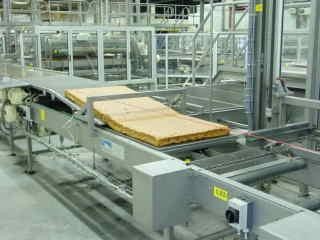
    Years ago I worked on a project where a new transport system had to unload large baking tins with cake (200×60 cm) automatically from an oven on to a conveyor track.

    For years the work was done by two men who stood beside the roaring hot oven mouth, picking up the hot baking tin with fireproof gloves, flipping it over with a bang to release the cake. And this every 10 seconds!

    There are many reasons one can think of to automate such a task and one would think that the cake bakers would rather spend their time differently. But I was wrong about that.

    These men thought it was a pretty fun job! And once you´d get the hang of it, there was even some time left to chat with your colleague at the other end of the tin. . .

    So many people find pleasure and honour in their work where others might think “There must be a smarter, more efficient way?”.

    In the coming decades engineers will find themselves in the same position as the craftsmen who they’ve made redundant over the past decades by automating their jobs.

    Now that’s a scary thought! The same feeling that all these production workers had when a new machine was rolled in that would do their job better and faster …

    “Nonsense! My work cannot be done by a machine.”

    And that is a reaction you hear from both the production worker as well as the knowledge worker.

    However, you can’t ignore a number of trends that have been going on for decades:.

    • automation (centuries)
    • digitization (for decades)
    • computing power increases exponentially (Moore’s Law)

    Partly because of these trends Artificial Intelligence is no longer something out of science fiction stories. The height of your insurance premium is determined by a knowledge system.  IBM’s Watson is even much more powerful … and available in the Cloud!

    Just like the production worker, the knowledge worker can’t deny these trends: even his work will be automated in the long run.

    “But then the knowledge will disappear!” cries out the production worker and knowledge worker in unison.

    Well no: knowledge is shifting. From the head and hands of people to machines and systems. ‘Retaining knowledge’ not only sounds better, it actually is!

    If there is anything to be learned from all those years of (production) automation, it’s that it ultimately does not cost jobs, but provides more prosperity. The cake bakers from the beginning of this story found other work. Work in which their skills were used in a new way. Work where they were good at, work they liked, work where they have learned new skills!

    And the Artificial Engineer? It will be your new colleague!

    Learn more? iDea Knowledge Based Engineering.
    [/av_textblock]